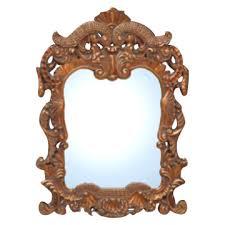
Mirror
I am silver and exact. I have no preconceptions.
Whatever I see I swallow immediately
Just as it is, unmisted by love or dislike.
I am not cruel, only truthful-
The eye of the little god, four cornered.
Most of the time I meditate on the opposite wall.
It is pink, with speckles. I have looked at it so long
I think it is a part of my heart. But it flickers.
Faces and darkness separate us over and over.
Now I am a lake. A woman bends over me,
Searching my reaches for what she really is.
Then she turns to those liars, the candles or the moon.
I see her back, and reflect it faithfully.
She rewards me with tears and an agitation of hands.
I am important to her. She comes and goes.
Each morning it is her face that replaces the darkness.
In me she has drowned a young girl, and in me an old woman
Rises toward her day after day, like a terrible fish.
- Sylvia Plath
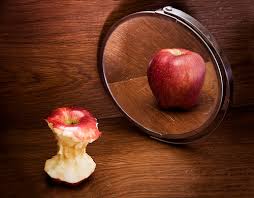
What I see in Sylvia's poem was this: She describes what is like to be a mirror and what the mirror's dispassionate, detached purpose is until she writes: "I have looked at it so long I think it is a part of my heart. [...] "Faces and darkness separate us over and over." What I think she is referring to here is the despair of loneliness and depression, of relationships come and gone, with none bearing the fruit of a soul- satisfying true love. "A woman bends over me. Searching my reaches for what she really is."
I think the woman, Sylvia perhaps, is looking at her reflection in the water. She feels lost, she is empty, she has no satisfying love in her life, perhaps she wasted her youth on a love that went nowhere. "Then she turns to those liars, the candles or the moon. I see her back, and reflect it faithfully." Now I took this in two ways. The first was that she turned away from looking at her reflection in the lake, turning her back toward it and the lake reflected her back back to her as a good mirror would. And I also took it to mean that the mirror "saw her back", in other words, the next time she picked up the mirror to look at herself. "She rewards me with tears and an agitation of hands." The woman's hands are agitated and how would the mirror know that if she were not clutching the handle in an agitated fashion or clutching at her face in despair, because she is also crying.
I believe she is looking with despair into the mirror because she see's that she's now old, and she's having a moment of absolute desperation, a moment of agonizing truth. She feels her life has no real meaning and has been wasted perhaps on a love as I mentioned that may never have worked out right because "she turns to those liars, the candles or the moon." To me candles signify romantic love and the moon represents promises, romance, dreaming of one's love, which can be a lie when the love you're dreaming of is inappropriate for you or not loving you in return. They also signify to me the softening of one's aging appearance in the soft light, rather than seeing the truth of aging in a brighter, truer light. She is definitely ageing because "In me she has drowned a young girl, and in me an old woman Rises toward her day after day, like a terrible fish."
Fish are for the most part, unattractive and ugly and aging can make a woman feel the same way. Her youth is passed and age is gaining on her. "Each morning it is her face that replaces the darkness."When one is depressed and unhappy with their life, one way to deal with the darkness is to just do what one must do every day, that is, you go through the motions, you get up, get yourself ready and get on with your day. When you've got no one loving you, and your life is at the pivotal point where you realize your youth is gone and you've done nothing with your life but involve yourself in a series of unsuccessful loves, your age will rise toward you "like a terrible fish"ß and repel you, most certainly. It's a terrible feeling. Trust me.